
Meet the Winners of the 2025-2026 Social Justice Fellowship Award
Level Justice is excited to announce the winners of the 2025-2026 Social Justice Fellowship Award: Tia Cristiano and Isabella McCloskey, of the University of Ottawa.
The Social Justice Fellowship Award recognizes an outstanding fellowship cohort that has shown exceptional work with Level’s Social Justice Fellowship Program (SJFP). As part of the program, Level recruited, trained, and funded law students nationwide who worked on unique social justice projects of their own design. The SJFP allows students to work closely with Level staff, not only to gain an in-depth understanding of social justice issues but also to advance their legal research, analysis, and writing skills. By engaging in the SJFP, fellows have the opportunity to learn about social justice issues, engage their campuses, perform outreach to the broader community, refine their leadership skills, and become better advocates for social justice.
Tia and Isabella’s project tackles the underrepresentation of marginalized communities in the Canadian legal profession through mentorship. Informed by an academic understanding of the benefits of mentorship, they developed and implemented a mentorship program, titled the Law Student Mentorship Program, bridging current and prospective law students.
Read more about their work in the Q&A below:
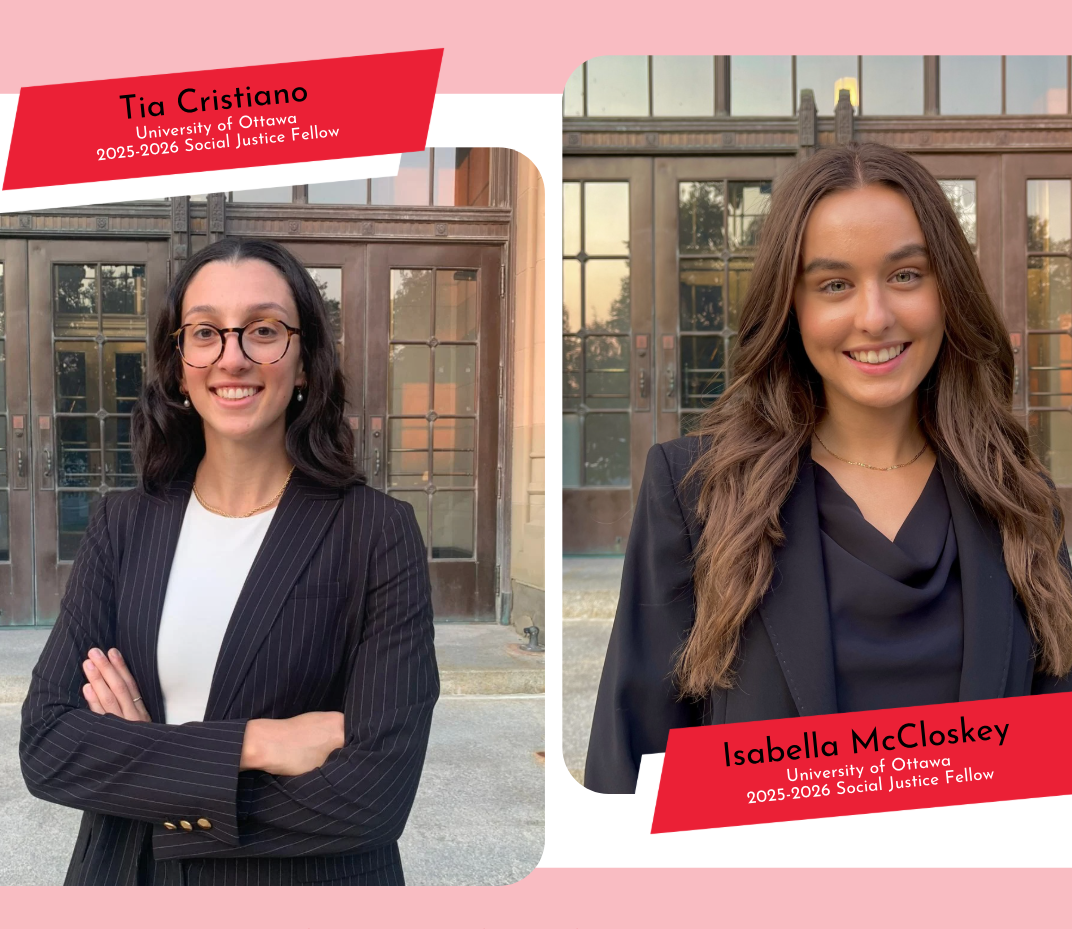
Tia Cristiano and Isabella McCloskey, 2025-2026 SJFP Fellows from the University of Ottawa, winners of the 2025-2026 Social Justice Fellowship Award.
Q: What inspired you to create the Law Student Mentorship Program?
A: Students from marginalized and underrepresented communities continue to face disproportionate barriers when navigating pathways into legal education. We noticed that there was a significant gap in mentorship programs, particularly for University-aged students. These barriers are shaped by a lack of representation, limited guidance, and the emotional weight of entering a profession that has not historically reflected their identities. We set out to build a program that responds to these realities by centering shared experience, accessibility, and individualized support.
Q: Why use mentorship to address underrepresentation?
A: Mentorship is not simply about improving application outcomes; it is about expanding what students believe is possible for themselves. Many of the prospective students we surveyed expressed uncertainty, anxiety, and a sense of being alone in the process. Accounts we received from students highlighted feelings of confusion and the need for reassurance. This made it clear that the absence of mentorship can make the path to law school feel overwhelming and inaccessible. The reflections we gathered from law students reminded us of a truth that guided our work: you can only dream as far as you can see. If students to not see people who look like them, share their identities, or understand their lived experiences, within the legal profession, it becomes harder to imagine themselves belonging there.
Q: What factors were used to determine mentorship pairings?
A: Designing the program required attention to matching mentors and mentees based on shared identities, interests, and preferences. Representation was treated as a core component of the program’s structure. The process of pairing students felt like building a community, one where students could see themselves reflected in someone just a few steps ahead of them. For mentees, that visibility alone was transformative. Several shared that mentorship made the legal profession feel more accessible, less intimidating, and more aligned with their own identities and aspirations.
Q: What were some of the notable impacts of your project?
A: One of the most powerful aspects of this project was reading the post-program reflections. Mentees described feeling more confident, more prepared, and more grounded. They spoke about the relief of having someone to ask “little questions” that they previously had no outlet for. They shared that the reassurance they received helped them see a legal career as “difficult but attainable”. Importantly, their reflections also affirmed something vital to our philosophy: the success of this program is not measured by whether students ultimately apply or attend law school. Instead, the success of the program looks like students feeling seen, supported, and capable of imagining themselves in the legal profession, whether now, later, or at all.
Tia and Isabella’s final report will be published in the 2026 Journal of Law Student Scholarship, coming Summer 2026.